 The Blanket
The Problem
Modern AI gives robots a powerful repertoire of skills. Yet most robots still struggle outside of carefully engineered environments.
When tasks change, conditions shift, or failures occur, robots often require specialists to come in and reprogram or retrain the robot. As a result, deployment remains costly, fragile, and difficult to scale.
The missing feature is a world model that allows robots to reason, adapt, and learn from experience, during deployment.
Our Solution
We use active inference, a computational framework inspired by how humans and other animals reason, act, perceive, and learn.
Rather than treating intelligence only as a collection of habits, i.e. observation-to-action mappings, we additionally equip robots with an evolving understanding of their environment.
This enables three core capabilities:
Online World Modelling
Robots build and continuously update structured world models during deployment, allowing them to understand and learn from changing situations in real time.
Knowledge Transfer
Information is represented in a way that allows knowledge gained in one task or environment to be reused in another, reducing retraining requirements.
Reasoning Under Uncertainty
Robots recognise when reality diverges from expectations, identify uncertainty, and take appropriate actions to resolve it.
Together, these capabilities culminate into self-learning robots that can adapt, recover from failures, and operate resiliently in dynamic environments.
Our Product: auto·motion
auto·motion is a reasoning software layer that sits on top of existing robotic systems. It enables robots to adapt to changing environments, learn new tasks with minimal data, and recover autonomously when things go wrong. This is possible due to efficient and online learning mechanisms and the way knowledge is represented in reusable ways.
Operator sets the goal
Operator demonstrates the task, or uploads design file in our no-code interface.
Plan & Execute
auto·motion breaks the task down in stages and begins execution.
Learn & Adapt
The system adapts online, self-calibrates, recovers from errors, and improves with use.
These capabilities not only relieve deployment costs, but also democratise robotics, especially as we are building a no-code operator interface. It allows any regular person to deploy robots, to do so much faster, and then just watch the self-learning robot reliably execute tasks.
Our long-term vision is to develop the robot brain that powers everything from industrial automation to robots used by small businesses and independent makers. We are starting with industrial robotics, where adaptation remains one of the largest barriers to deployment and where the value of adaptive intelligence is most immediate.
About Us
Why “The Blanket”?
It is named after the Markov Blanket, a statistical boundary that separates an agent from its environment, defining where an agent ends and the world begins. It is through this boundary that an agent senses and acts on its world. We see adaptive intelligence as emerging from this continuous interaction between understanding and action.
Team

Riddhi
Jain Pitliya
CEO
PhD, University of Oxford
Founder
Tim
Verbelen
CTO
PhD, Ghent University
Founder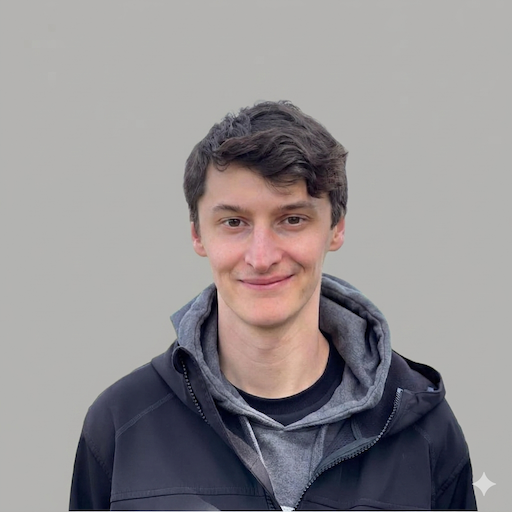
Toon
Van de Maele
Head of AI
PhD, Ghent University
Founder
Corrado
Pezzato
Head of Robotics
PhD, TU Delft